After a decade working at 38,000 feet, I’ve collected more stories than I can count. The training, the responsibility, the lifestyle, the friendships, the exhaustion, the pride – it’s so much more than just a job. The confidence it builds, the people it brings into your life, and the perspective you gain from seeing the world in such an intimate, unusual way. This is my own personal story from the past 10 years flying around the world. I hope it helps and inspires anyone else considering becoming cabin crew.
This guide reflects my own opinions and personal experience. It does not represent the views or policies of any airline or employer, past or present, and should not be taken as official guidance or endorsement.
This post contains affiliate links. If you book or buy through them, I may earn a small commission at no extra cost to you, which helps keep this blog running. You can read how your data is handled in the privacy policy. If you found this helpful, and would like to support this little corner of the internet you can do so here.
Life Before Becoming Cabin Crew
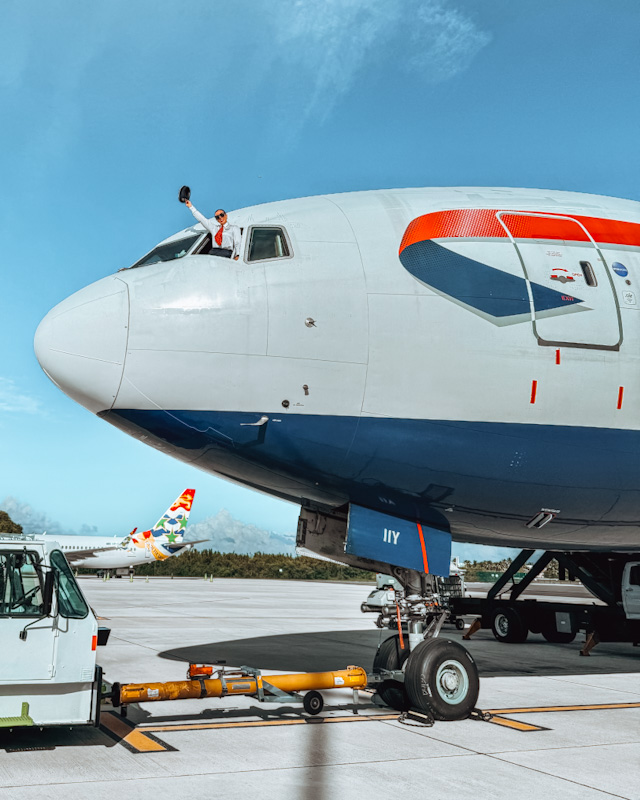
I spent 10 years calling the sky my workplace. Flying 2,593,657 miles on 841 flights to 66 countries across 6 continents and worked on some of the best aircrafts in the world (Boeing 747 Jumbo, Boeing 787 Dreamliner, Boeing 777, Airbus 380 and Airbus 320) and worked in all the cabins from economy right up to first class. But the dream started long before that. At around 14, I started thinking about becoming cabin crew. On every flight, I watched the crew with absolute awe. The way they moved through the cabin, the confidence, the polished uniforms, and the freedom of travelling the world. Seeing them walk through the airport, they always appeared so put together and worldly.
After leaving school, I knew I wanted a career in travel. So I studied Travel and Tourism at college and added a cabin crew module. I later went on to study Travel and Tourism Management at university. You don’t need qualifications to become crew, but I wanted a foundation and extra experience in the industry. Plus I knew I had my whole life to work full‑time.
After graduating, I played it safe for a few years, working in hotels, then as a travel agent and in ticketing. The company I was with went through major restructuring, and I found myself miserable in a job that didn’t excite me. At 26, I realised there had to be more to life than a 9–5 I didn’t enjoy. So I applied to 2 major UK airlines based at Heathrow.
Becoming crew is incredibly competitive, and I honestly didn’t think I stood a chance. I assumed I’d need to start with a low‑cost carrier first. But I applied on a whim and to my surprise, I was invited to both interviews.
The Interview That Changed My Life
One of the airlines I applied to invited me to a telephone interview first. But the airline I really wanted called me straight to their assessment day, and it was scheduled before the other one. So off I went to their head office at Heathrow, dressed to the nines – smart outfit, hair in a bun, pearl earrings, red lipstick, neck scarf etc. I was a bundle of nerves.
The day began with a welcome from current crew sharing their stories. Followed by a series of tasks: a team exercise, a difficult‑customer role play, reading a PA, and a basic knowledge test. After that, we were split into 2 rooms – those who made it through to the next stage and those who didn’t. I’ll never forget the relief and excitement when my group realised we’d made it. We hugged, celebrated, and then headed to lunch before the interview process began.
By the time my interview came around, my nerves were sky‑high. I said a few things that seemed to land well, but the interviewers kept very neutral, and I walked out convinced I’d blown it. Sean picked me up, and I remember saying to him “I don’t think I got it.”
The next day, while I was sitting at my desk at work, an email flashed up on my phone – I’d been successful. I was so surprised. From there, I had to complete security checks and provide more background information before training could begin. I’d landed my dream job with the airline I really wanted to work for. Without hesitation, I cancelled my other assessment day with the other airline. Everything was about to change.
You may also find this blog post helpful: Becoming Cabin Crew: Advice, Requirements & Information
The Waiting Game
After my assessment day, I was placed into a cabin crew holding pool. Airlines often recruit in large groups even when they don’t have immediate vacancies. The process of becoming cabin crew is long. Background checks, medicals, uniform fittings, and then 6 weeks of intense training are all required before you even start flying. Having a pool means they can bring people in quickly when crew leave or retire. It took around 6 months from my interview to the start of my training.
Cabin Crew Training
I began my training back on 17th April 2015. Those 6 weeks were some of the most demanding of my life. People love to joke that cabin crew are glamourised waitresses in the sky. But the amount you need to learn before you’re allowed anywhere near an aircraft is A LOT! There were just 13 of us on my course, and by the end we felt like a little family, cheering each other on because even after getting that far, failing the training meant no job.
The first 4 weeks were the toughest. We covered every emergency procedure and drill imaginable: evacuations, ditching, decompression, survival, fire fighting, dangerous goods, equipment, medical scenarios, hijack and bomb threat protocols, restraint techniques, and all the aircraft types we’d be licensed on. Today it’s all done online, but back then we had massive manuals to carry around and study from.
The final 2 weeks focused on looking after passengers and learning about the service in each cabin. Every week brought exams, drills, and role plays, and you only got 3 snapshots (strikes/fails) before you were out. The pressure was real, all of us had left jobs to be there, and we were desperate to get our wings.
For the full 6 weeks, you had to look immaculate and never be late, both could earn you a snapshot. My days started at 2–3am so I could drive an hour to Heathrow, beating the traffic just in case. I’d sit and revise with a few others who were doing the same. It was exhausting, intense, and unforgettable.
The Day I Got My Cabin Crew Wings
On our final day of training, we arrived in full uniform. The only thing missing was the wings pin. Pilots and cabin crew receive their wings once they’ve passed their training. Every airline has its own version, usually styled around the airline’s logo.
After 6 intense weeks of exams, drills on aircraft mock‑ups, and countless visits to the hangars for aircraft visits, the excitement for our wings ceremony was unreal. I can still picture us all fussing over each other’s uniforms, checking a hair wasn’t out of place and making sure no one had red lipstick on their teeth. Uniform standards were much stricter back then, and we weren’t taking any chances.
When the moment finally came, we were handed our wings, our cabin crew certificate, and our cabin crew attestation – our official cabin crew license. And just like that, the very next day, we were operating our first flights.
My Very First Flight As Cabin Crew
Just over a month into training, we finally received our first rosters. My flight was a Budapest there‑and‑back for my supernumerary flight (the first flight after training, where you’re essentially an extra crew member). The rest of my roster consisted of Tel Aviv, Chicago, Johannesburg, Dallas, and Nairobi. The excitement was unreal – even now I get goosebumps thinking about it. Coming from a very working‑class background, raised in a single-parent household on a council estate, the idea of flying to places like these felt like a dream.
For that first flight, I arrived ridiculously early. I was nervous and I wanted to make the best impression possible. So I sat rereading my notes to make sure I was fully prepared. The crew that day were so kind, guiding me through everything and reminding me that real‑world flying feels very different from the training room. Suddenly we were actually in the air, with a full cabin of passengers.
Takeoff and landing were spent in the flight deck, something all new crew get to do on their first flight. Watching the pilots at work during the most critical stages, listening to air traffic control, seeing the world from above – it was incredible.
That first month of flying was crazy in the best way. I soaked up every moment, both on the aircraft and during layovers: eating delicious Israeli food in Tel Aviv, sightseeing in Chicago, joining a safari in Johannesburg, shopping in Dallas, and celebrating my 27th birthday in Nairobi. It was everything I’d hoped for and more.
That Jet Set Life
When I first applied to become cabin crew, I imagined I’d do it for a year or 2. Most people join with that mindset, but time really does fly when you’re having fun (pun intended). A whole decade disappeared in what feels like a heartbeat, and even now it sometimes feels like a distant memory. The stories, the chaos, the surreal moments…there are enough to fill a book, and I know every crew member would say the same. The job is a wild ride from start to finish.
Life as full‑time crew means you can wake up in Tokyo and, a few days later, be strolling through New York’s Central Park with a coffee in hand. Every flight and every layover brings something completely different. I never took that for granted. I treated each stopover like a mini city break – exploring, eating, wandering, soaking it all in. The only times I stayed in my hotel room were on minimum‑rest nights or in destinations where we weren’t allowed to leave for safety reasons.
Trying to summarise my journey feels impossible because there were so many standout moments: sitting in the flight deck for takeoff and landing, visiting Heathrow’s air traffic control tower to see the hard work behind the scenes, serving celebrities and royalty in first class, and exploring some of the most beautiful cities and countries in the world. It was a decade of experiences I’ll never forget both onboard the aircraft and off of it.
The Highs & Lows
Being cabin crew is a rollercoaster ride. The highs are so so so high, and the lows are so f*cking low. It’s a job of extremes, where every flight and every layover feels completely different. No day at the “office” ever repeats itself. The airline I worked for had around 15,000 cabin crew, which meant an enormous workforce and a mind‑blowing logistical operation just to get a single aircraft into the air.
Because everyone works to different flying patterns, all governed by strict legal rest rules set by the CAA (Civil Aviation Authority), EASA (European Union Aviation Safety Agency), and supported by cabin crew unions – you’re constantly paired with new colleagues. It’s rare to fly with the same people.
On top of that, you’re hopping between destinations with completely different cultures, passenger profiles, and time zones. So much of the role is about taking things in your stride, staying unfazed when plans shift, and thinking on your feet at a moment’s notice. It’s intense, unpredictable, and demanding.
The highs
There are so many highs to the job, and that’s exactly why I stayed so long, nothing else compares. It’s no surprise that so many crew stay until retirement. It’s an incredibly hard career to walk away from. The travel alone is a huge draw. You’re literally paid to see the world, and with repeated trips, you start to build real connections with places. Cities like Singapore and Cape Town became second homes to me after nearly 30 visits each.
The perks are pretty good as well. Standby flights, upgrades, and the chance to bring loved ones along on work trips were some of my favourites. Watching family and friends sit in premium cabins while I served them felt priceless, as it was something none of us could normally afford.
One of the best parts of the job is the people. The job attracts a certain type of person – warm, funny, chatty, and always up for a laugh. Most flights end with deep 3am jump‑seat chats over a cuppa, and you quickly learn each other’s life stories. You’re all far from home, dealing with your own stuff, and when something serious happens, you pull together without question. Crew become a little family on every flight – you really have to look out for one another up there.
The lows
No job is perfect, and cabin crew definitely has its extreme lows. The hours can be brutal! I’ve never known tiredness like it. Some days you’re awake and on the go for 20–30+ hours, especially if you report late in the evening after being up since the morning. And it’s never just the flight itself. There’s getting ready, travelling to the airport, parking, the staff bus, swiping in, reading updates, briefing, security, walking to the gate, and the chaos of boarding – all before takeoff. Add a long‑haul sector, like a 15‑hour Santiago, plus immigration and the crew bus to the hotel, and by the time you reach your room, you feel like you’ve been awake for a lifetime. Working at altitude also adds to the exhaustion.
Being away from home is another challenge. Unlike a standard job, you don’t go home after your outbound flight. Long‑haul crew are away for days at a time. You miss birthdays, Christmases, and big life moments because flights operate 24/7, 365 days a year. And no matter how tired or homesick you are, passengers have paid a lot of money to fly, so you show up with a smile. Not everyone is travelling for happy reasons, so you do meet the occasional grumpy passenger. I was lucky in 10 years, only 1 ever made me cry (and I was definitely overtired).
Even days off aren’t really days off. Jet lag wipes you out, and landing day is usually a write‑off, especially after a red‑eye. Most crew spend it sleeping, delirious, and moving through the day like zombies.
My Last Ever Flight As Cabin Crew
After 10 years and serving more chicken‑or‑beef than I can remember, it was finally time to hang up my wings. Sean and I had talked and planned for travelling full‑time for many years, and Pretty Planet was growing from a side hustle into something more. I still loved flying, but after the pandemic, everything felt different, including me. I was ready for a new chapter.
My roster for my final month in the skies was a dream – Hong Kong, Johannesburg, and Tokyo. The crews on those trips made leaving even harder, they spoiled me, supported me, and made every moment feel special. I took a friend to Hong Kong for 1 last layover adventure (with a quick trip to Macau), treated myself to a final safari in Johannesburg, and soaked up cherry blossom season in Tokyo for my last trip as crew.
“Cabin crew doors to manual and cross check”
That last flight back into London felt surreal. The crew were so kind, the passengers were lovely, and I sat in the flight deck for a final time for takeoff. Hearing “cabin crew, doors to manual and cross‑check” one last time as we landed back into Heathrow broke me. I cried in the galley, the manager and pilot were emotional, and a first‑class passenger I’d bonded with was also in bits. I held back the tears the entire drive home, but the moment I stepped through the front door I fell apart. That’s when it really hit me just how much I was going to miss the job and lifestyle that came with it.
I was ready to move on, but I owe so much to this job. It shaped me, showed me the world, and gave me memories I’ll carry forever. I’ll never say never to returning, but for now, I’m excited to build my little travel business on my own terms. Thank you to my airline, my crews, every passenger, and my loved ones – you gave me the decade of a lifetime, and I’ll never forget it.
See some of my crew memories from over the years here.
Browse my Amazon Storefront for the best cabin crew travel gadgets and accessories for your next flight.
You may also find these other blog posts helpful:
- Becoming Cabin Crew: Advice, Requirements & Information
- Packing Made Easy: Tips, Lists & Must-Haves
- The Jet Lag Survival Guide: Essential Tips For Travellers

Thanks for reading! If you enjoyed this post, feel free to comment, subscribe, or follow along on socials for more travel inspo. Some links may be affiliate at no extra cost to you, helping support Pretty Planet and keep the free advice flowing. If you found this helpful, and would like to support this little corner of the internet you can do so here. Your support means the world. Happy travelling!



Leave a Reply